- Shopping, made easy.
- /
- Get the app!
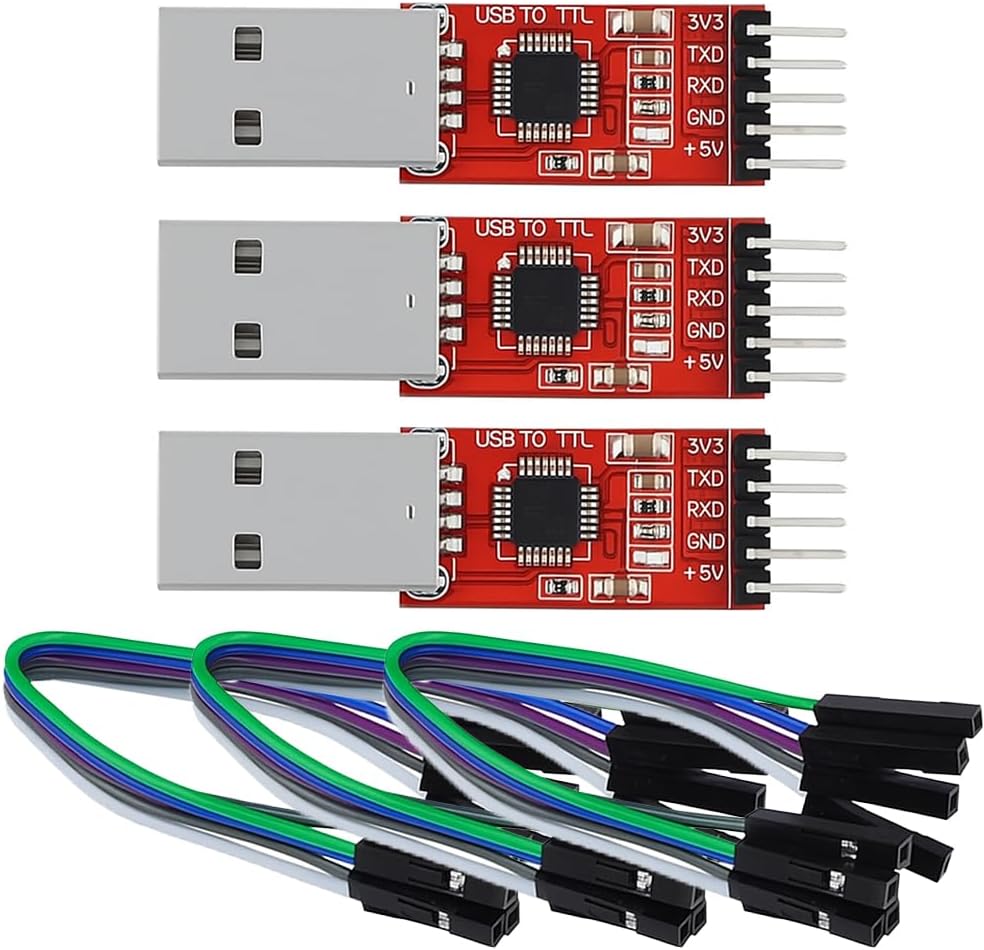
Enhance your development and debugging experience with this CP2102 USB 2.0 to TTL UART 6-Pin Serial Converter Module, designed for reliable communication between your computer and microcontrollers (MCUs). Ideal for developers, hobbyists, and engineers working with Arduino, ESP8266, STM32, STC, and other embedded systems.
Key Features:
Reliable CP2102 Chipset: Built around the stable and trusted CP2102 chip, which automatically creates a virtual COM port after driver installation. Ensures consistent performance and compatibility with a wide range of systems.
USB Powered with 3.3V/5V Output: The module draws power from the USB port and provides output pins for 3.3V (max 40mA) and 5V, along with GND, TXD, RXD, and RST. All signal lines use 3.3V TTL logic (positive logic), making it compatible with most 3.3V or 5V devices.
Onboard Indicator LEDs: Includes three LEDs—power/status LED remains ON when the driver is installed correctly, while TX and RX LEDs flash during communication. The higher the baud rate, the lower the brightness, allowing for easy visual monitoring of transmission activity.
Flexible Baud Rate & Communication Format: Supports baud rates from 300 bps to 1 Mbps, and various serial communication settings:
Data bits: 5, 6, 7, or 8
Stop bits: 1, 1.5, or 2
Parity: None, Odd, Even, or Mark
Buffer & Flow Control Support: Built-in byte receive buffer and 640-byte transmit buffer. Supports hardware flow control and X-ON/X-OFF software handshake. Supports USB suspend mode via the SUSPEND pin and broken line (disconnection) detection.
TTL vs RS232 Logic Explanation: This module uses TTL logic (0V = logic “0”; +3.3V or +5V = logic “1”), which is positive logic. In contrast, RS232 uses inverted signals (−12V to −3V = logic “1”; +3V to +12V = logic “0”).
Wide Operating System Compatibility: Fully compatible with Windows 98SE, 2000, XP, Vista, 7, 10, 11, Mac OS 9/X, and Linux kernel 2.4 and above.
Industrial Temperature Range: Operates reliably between −40°C to +85°C, suitable for harsh environments and industrial use.
 Dual Link DVI Cable – with ferrite core for Interference-Free Signal Transmission – 20ft (Digital DVI-D/24+1 Monitor Cable, DVI to DVI, up to 2560×1600 at 60Hz or Full HD/1080p) by CableDirect
KWD 3.500
Dual Link DVI Cable – with ferrite core for Interference-Free Signal Transmission – 20ft (Digital DVI-D/24+1 Monitor Cable, DVI to DVI, up to 2560×1600 at 60Hz or Full HD/1080p) by CableDirect
KWD 3.500
 DiliVing SlimSAS LP 8X to 2*MiniSAS HD 4X,SFF-8654 LP 74pin to 2*SFF-8643 36pin Cable 80cm(Suitable for DELL Server H750/755)
KWD 10
DiliVing SlimSAS LP 8X to 2*MiniSAS HD 4X,SFF-8654 LP 74pin to 2*SFF-8643 36pin Cable 80cm(Suitable for DELL Server H750/755)
KWD 10
 InstallerParts (10 Pack Ethernet Cable CAT5E Cable UTP Booted 10 FT - White - Professional Series - 1Gigabit/Sec Network/Internet Cable, 350MHZ
KWD 11
InstallerParts (10 Pack Ethernet Cable CAT5E Cable UTP Booted 10 FT - White - Professional Series - 1Gigabit/Sec Network/Internet Cable, 350MHZ
KWD 11
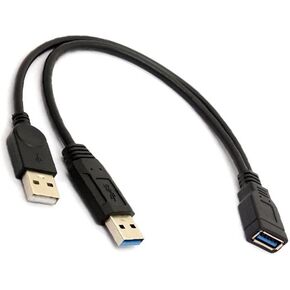 ALINNA Black USB 3.0 Female to Dual USB Male Extra Power Data Y Extension Cable Splitter Adapter for 2.5" Mobile Hard Disk
KWD 2.500
ALINNA Black USB 3.0 Female to Dual USB Male Extra Power Data Y Extension Cable Splitter Adapter for 2.5" Mobile Hard Disk
KWD 2.500