- Shopping, made easy.
- /
- Get the app!
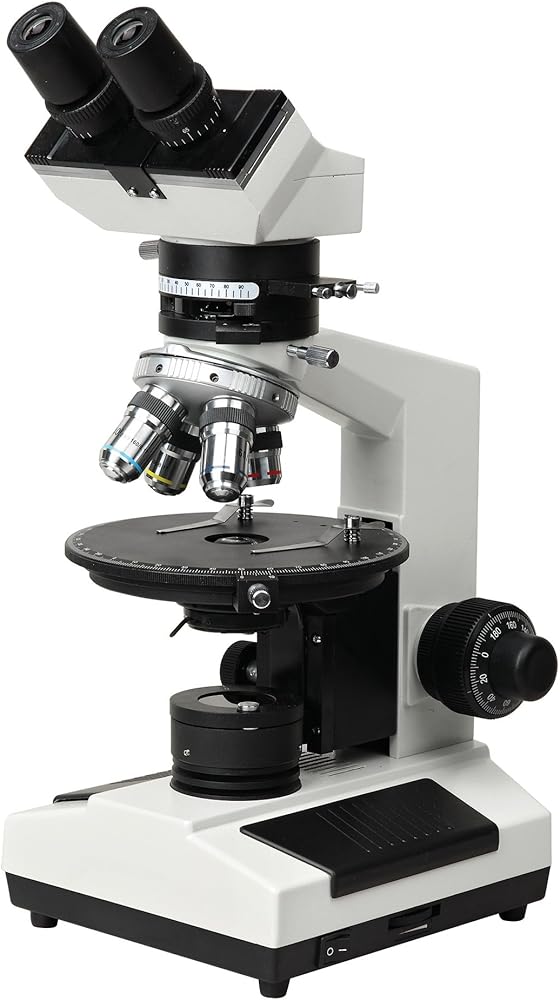
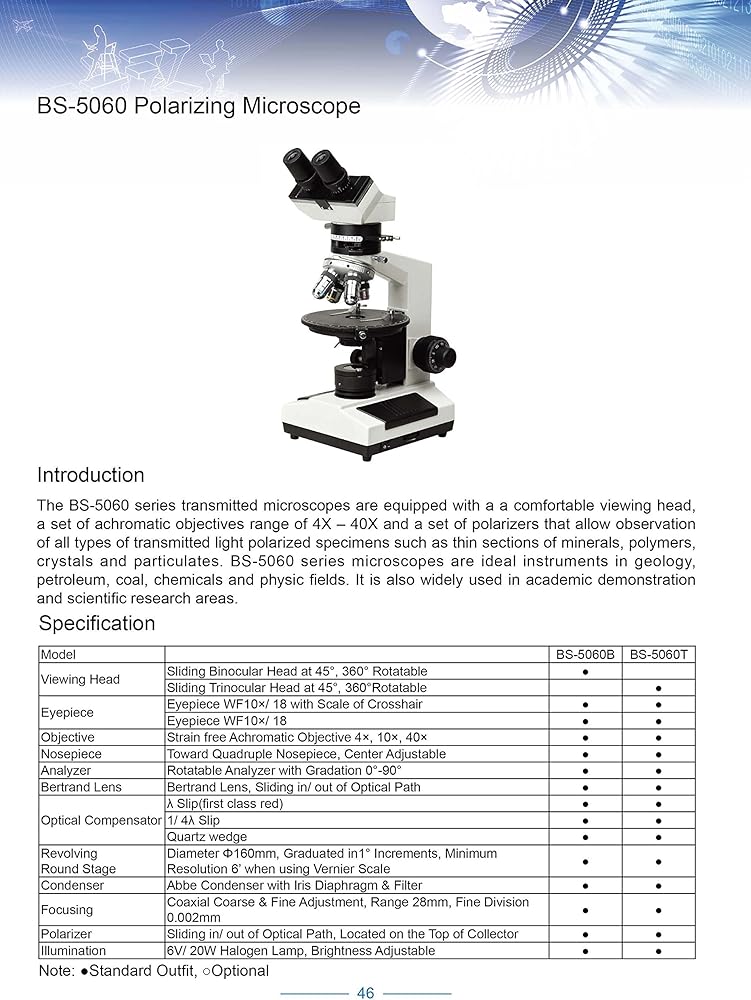
The BestScope BS-5060T Polarizing Trinocular Compound Microscope has a pair of 10x widefield eyepieces (one with crosshair scale), a Bertrand lens, a 23.2mm trinocular port, a forward-facing nosepiece with three strain-free achromatic objectives, transmitted halogen illumination, coaxial nested coarse and fine focus, an Abbe condenser with iris diaphragm, and a rotating round stage. The built-in Bertrand lens enables viewing of conoscopic images (interference figures). The trinocular viewing head has a binocular head with a pair of eyepieces that slide to adjust interpupillary distance, fixed inclination to reduce eye and neck strain, and 360-degree rotation capability to provide a more comprehensive view and enable sharing; and a trinocular port that accepts a camera adapter (sold separately). A forward-facing nosepiece eases changing objectives. Strain-free objectives minimize distortion. Achromatic objectives provide color correction of magnified images. A transmitted polarizing microscope uses transmitted light and a polarizing unit to enhance contrast for viewing thin sections of minerals, polymers, crystals, and particulates in geological, metallurgical, chemical, pharmaceutical, and industrial applications.
The microscope has lower (diascopic) illumination that transmits light up through the specimen for enhanced visibility of translucent and transparent objects. It has a rotatable analyzer and a polarizer that can slide into and out of the optical path. The halogen light source provides bright light in a concentrated path, and a rheostat controls the amount of light emanating from the lamp. The Abbe condenser can be adjusted to control the distance of the light from the stage, and has an iris diaphragm to optimize the amount of light illuminating the specimen. The round stage rotates to position specimens, and is graduated in 1-degree increments. Coaxial coarse and fine focus knobs are nested to speed focusing for left-and right-handed viewers.
Microscope Head and Optics SpecificationsHeadTrinocular, slidingMagnification range40x-400xTrinocular port23.2mmBinocular head inclination45 degreesEyepieces (18mm)WF10x, WF10x with crosshair scaleNosepieceQuadruple, forward-facingObjectives, strain-free achromatic4x, 10x, 40x
Microscope Illumination and Stage SpecificationsFocus typeCoaxial coarse and fineCondenserAbbeLight sourceHalogen with rheostat, 6V/20WDiaphragmIrisIllumination typePolarizing, transmittedStage typeRound, rotatingStage diameter160mmPower110V
Microscopes are instruments used to enhance the resolution of an object or image. Types include compound, stereo, or digital. Compound microscopes use a compound optical system with an objective lens and an eyepiece. Stereo microscopes show object depth in a three-dimensional image. Digital microscopes are used to display an image on a monitor, rather than looking through a lens. Microscopes can have monocular (one), binocular (two), or trinocular (three) eyepieces, with varying magnification abilities. Magnification ability refers to the size of an image. Resolution, also known as resolvant power, refers to the clarity of the image. The interaction between field of view (FOV), numerical aperture (NA), and working distance (WD) determines resolution. Microscopes can control magnification through a fixed focus, or through a range of adjustments. They can also utilize LED, fluorescent, and mirror light sources to help control viewing capabilities. Microscopes are widely used in education, lab research, biology, metallurgy, engineering, chemistry, manufacturing, and in the medical, forensic science, and veterinary industries.
BestScope International Ltd. manufactures microscopes, digital cameras, and accessories for education, inspection, research, and clinical and industrial applications. The company, founded in 1995, is headquartered in Beijing, China.
What's in the Box?BestScope BS-5060T Polarizing Trinocular Compound Microscope
WF10x eyepiece, 18mm
WF10x eyepiece with crosshair scale, 18mm
4x strain-free achromatic objective
10x strain-free achromatic objective
40x strain-free achromatic objective
 OMAX 40X-2500X Phase Contrast Trinocular Compound Siedentopf LED Microscope with Special 100X Oil Darkfield Objective
KWD 489
OMAX 40X-2500X Phase Contrast Trinocular Compound Siedentopf LED Microscope with Special 100X Oil Darkfield Objective
KWD 489
 Parco Scientific PA-5FZ-IFR07 Trinocular Zoom Stereo Microscope,10xWF Eyepiece,0.7X-4.5X Zoom,3.5x-90x Magnification,0.5X&2X Auxiliary Lens,Double Arm Boom Stand,144-LED Ring Light
KWD 212
Parco Scientific PA-5FZ-IFR07 Trinocular Zoom Stereo Microscope,10xWF Eyepiece,0.7X-4.5X Zoom,3.5x-90x Magnification,0.5X&2X Auxiliary Lens,Double Arm Boom Stand,144-LED Ring Light
KWD 212
 Parco Scientific PA-5FZ Simul-Focal Trinocular Zoom Stereo Microscope, 10x WF Eyepiece, 0.7X—4.5X Zoom, 3.5X—90x Magnification, 0.5X & 2X Auxiliary Lens, Double Arm Boom Stand
KWD 201
Parco Scientific PA-5FZ Simul-Focal Trinocular Zoom Stereo Microscope, 10x WF Eyepiece, 0.7X—4.5X Zoom, 3.5X—90x Magnification, 0.5X & 2X Auxiliary Lens, Double Arm Boom Stand
KWD 201
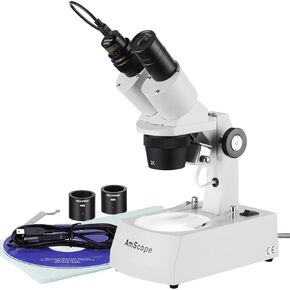 AmScope SE306R-AZ-E Digital Forward-Mounted Binocular Stereo Microscope, WF10x and WF20x Eyepieces, 20X/40X/80X Magnification, 2X and 4X Objectives, Upper and Lower Halogen Lighting, Reversible Black/White Stage Plate, Arm Stand, 120V, Includes 0.3MP Came
KWD 95.500
AmScope SE306R-AZ-E Digital Forward-Mounted Binocular Stereo Microscope, WF10x and WF20x Eyepieces, 20X/40X/80X Magnification, 2X and 4X Objectives, Upper and Lower Halogen Lighting, Reversible Black/White Stage Plate, Arm Stand, 120V, Includes 0.3MP Came
KWD 95.500