- Shopping, made easy.
- /
- Get the app!
Specification:
For the amplification, we use the Maxim MAX4466, an op-amp specifically designed for this delicate task!
The amplifier has excellent power supply noise rejection, so this amplifier sounds really good and isn't nearly as noisy or scratchy as other mic amp breakouts we've tried!
You can set the gain from 25x to 125x. That's down to be about 200mVpp (for normal speaking volume about 6" away) which is good for attaching to something that expects 'line level' input without clipping
It's up to about 1Vpp, ideal for reading from a microcontroller ADC, the output is rail-to-rail so if the sounds gets loud, the output can go up to 5Vpp!
For the best performance, use the "quietest" supply available (on an Arduino, this would be the 3.3V supply). The audio waveform will come out of the OUT pin.
The output will have a DC bias of VCC/2 so when its perfectly quiet, the voltage will be a steady VCC/2 volts (it is DC coupled). If the audio equipment you're using requires AC coupled audio, place a 100uF capacitor between the output pin and the input of your device. If you're connecting to an audio amplifier that has differential inputs or includes decoupling capacitors, the 100uF cap is not required.
 50pcs 20MHZ 20.000M HZ HC-49S Crystal Oscillator Arduino Raspberry Breadboard
KWD 4
50pcs 20MHZ 20.000M HZ HC-49S Crystal Oscillator Arduino Raspberry Breadboard
KWD 4
 Rubber Cushioned Insulated Clamps with Bolts, 304 Stainless Steel Cable Clamps, R-Type Shockproof Metal Clamp, Tube Holder for Tube, Pipe, Wire Cord Installation (Φ8)
KWD 2
Rubber Cushioned Insulated Clamps with Bolts, 304 Stainless Steel Cable Clamps, R-Type Shockproof Metal Clamp, Tube Holder for Tube, Pipe, Wire Cord Installation (Φ8)
KWD 2
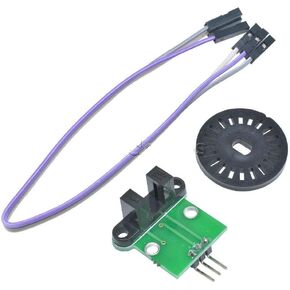 HC-020K Double Speed Measuring Sensor Module with Photoelectric Encoders Kit
KWD 3
HC-020K Double Speed Measuring Sensor Module with Photoelectric Encoders Kit
KWD 3
 TB6560AHQ PWM Chopper Bipolar Driver IC for Stepper Motor Controller
KWD 2.500
TB6560AHQ PWM Chopper Bipolar Driver IC for Stepper Motor Controller
KWD 2.500