- Shopping, made easy.
- /
- Get the app!
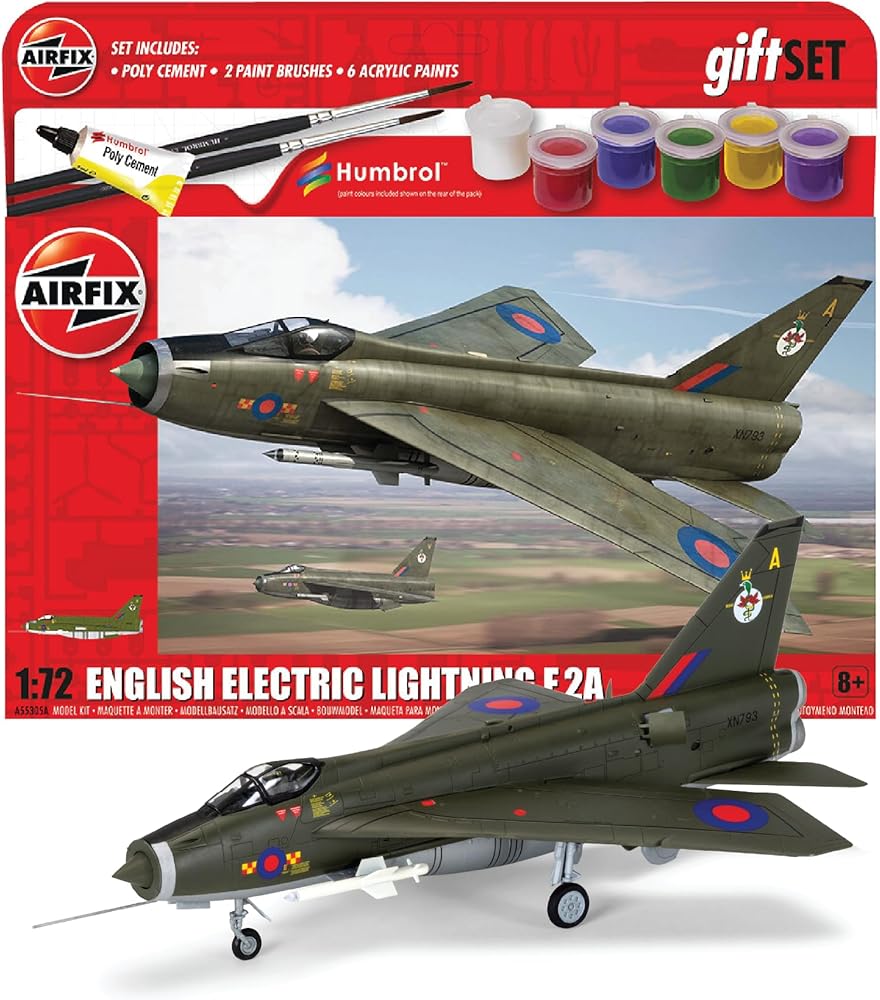
After World War II, the Cold War began to boil to the surface in 1947; building tension between superpowers, creating a race to build the fastest jets as well as the most poweful nuclear weapons. During the 1950s, there was a race to reach Mach 2. The Soviet Union presented an aircraft that had already reached Mach 1.5 with their jet, as there was no other aircraft that could catch the Tupolev Tu-22, Britain fired back. The English Electric Ligtning earned its name because of its supersonic speed, being developed as a interceptor fighter, it refused to be left in the dust. The English Electric Lighntning entered service for the RAF in 1959, sporting the fastest climb rate of any other jet at 20,000 feet per minute to classified heights. The F2A variant, was developed in 1966, showcased the longest tactical range of all the upgrades featuring a 2 hour flight endurance and was used in low-altitude interception.
 Airfix Vintage Classics LCM3 & Sherman 1:76 WWII Military Ground & Water Vehicles Plastic Model Kit A03301V
KWD 7
Airfix Vintage Classics LCM3 & Sherman 1:76 WWII Military Ground & Water Vehicles Plastic Model Kit A03301V
KWD 7
 Airfix JagdPanzer 38 Tonne Hetzer Early Version 1:35 WWII Military Tank Plastic Model Kit A1355, Multi
KWD 11.500
Airfix JagdPanzer 38 Tonne Hetzer Early Version 1:35 WWII Military Tank Plastic Model Kit A1355, Multi
KWD 11.500
 Airfix Quickbuild Airfix Vintage Classics Bren Gun Carrier & 6 PDR Anti-Tank Gun 1:76 Military Ground Vehicles Plastic Model Kit A01309V, Multicolor
KWD 5
Airfix Quickbuild Airfix Vintage Classics Bren Gun Carrier & 6 PDR Anti-Tank Gun 1:76 Military Ground Vehicles Plastic Model Kit A01309V, Multicolor
KWD 5
 Airfix A01071B Supermarine Spitfire Mkia 1:72 Model Building Kit (36 Piece), Multicolor
KWD 8
Airfix A01071B Supermarine Spitfire Mkia 1:72 Model Building Kit (36 Piece), Multicolor
KWD 8