- Shopping, made easy.
- /
- Get the app!
Minimum Measurement (Inch):2"
Minimum Measurement (Decimal Inch) :2.0000"
Maximum Measurement (Inch):6"
Maximum Measurement (Decimal Inch):6.0000"
Graduation (Decimal Inch):0.0005"
Gage Depth (Inch):9-1/2"
Gage Depth (Decimal Inch):9.5000"
Measurement Accuracy:0.0009"
Repeatabilit:0.0004"
Self-centering error:0.00025”
Internal diameter gauges measure holes in workpieces. They can measure the internal diameter of a hole at any depth (2"-6"), whereas an inside diameter micrometer can only measure to the depth of its contact. Internal diameter gauges are usually calibrated with a setting ring and come in two types: simple and direct measurement. Simple bore gauges are used in conjunction with calipers to transfer the measurement of the bore, while more complex bore rules measure directly and are indicated by a vernier, dial or digital display. Bore gauges have two or three points of contact, indicating how many points on the gauge head are in contact with the inside of the hole. Two-point contact is better for measuring ellipticity, while three-point contact is suitable for measuring lobes or triangular-shaped errors. Pistol gauges are used for quick, one-handed operation with repeatable results between operators. Bore gauges also be suitable for special applications such as measuring threads, spline pitch diameters and deep holes.
Adjustable anvil holders are available in different lengths suitable for measuring holes, cylinders or pipes of different depths. These manual bore gauges are a friendly tool suitable for a variety of inspection and calibration applications in the automotive, manufacturing, construction and other industries. The carbide anvil enables the gauges to withstand temperature changes and wear, thus ensuring a long tool life. They are also suitable for measuring deeper bore diameters. Mechanics, machinists and other professionals use these dial bore gauges to measure the wear of cylindrical objects. These gauges are also used to measure bores in engine blocks, to check the internal dimensions of injection moulded parts and to track the wear of surfaces for repair purposes.
 -4%
Wixey Digital Angle Gauge Type 2 with Magnetic Base and Backlight…
KWD 13
-4%
Wixey Digital Angle Gauge Type 2 with Magnetic Base and Backlight…
KWD 13
 Mitutoyo 02AZF300 Connection Unit Standard Type
KWD 47
Mitutoyo 02AZF300 Connection Unit Standard Type
KWD 47
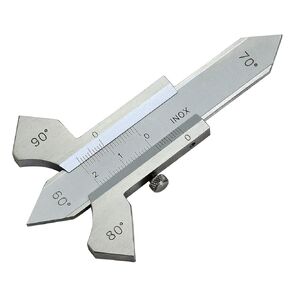 RIVERWELD Digital Readout Welding Gauge Weld Test Ulnar & Both Metric & Inch
KWD 5.500
RIVERWELD Digital Readout Welding Gauge Weld Test Ulnar & Both Metric & Inch
KWD 5.500
 marddpair 6 Pcs 0-6 Outside Micrometer 0.0001 Carbide Standards Micrometers
KWD 24.500
marddpair 6 Pcs 0-6 Outside Micrometer 0.0001 Carbide Standards Micrometers
KWD 24.500